
Virginia won one of its two appeals on Monday over how far it can go in setting the terms of immigration enforcement within its borders. The U.S. Court of Appeals for the Fourth Circuit vacated an August 31 preliminary injunction that protected existing agreements between federal immigration authorities and Virginia state or local agencies. It upheld a separate preliminary injunction blocking Virginia from applying its mask and identification law to federal personnel involved in immigration enforcement.
The agreements take their name from Section 287(g) of the Immigration and Nationality Act. It authorizes written agreements under which qualified state or local personnel can perform specified immigration officer functions under federal supervision. Virginia’s law sets conditions for that cooperation. Its text says agreements in effect on July 1 are void and unenforceable if they were not modified in writing by September 1 to meet the new terms. The August injunction concerned existing agreements. The appeals court did not determine the status of individual agreements.
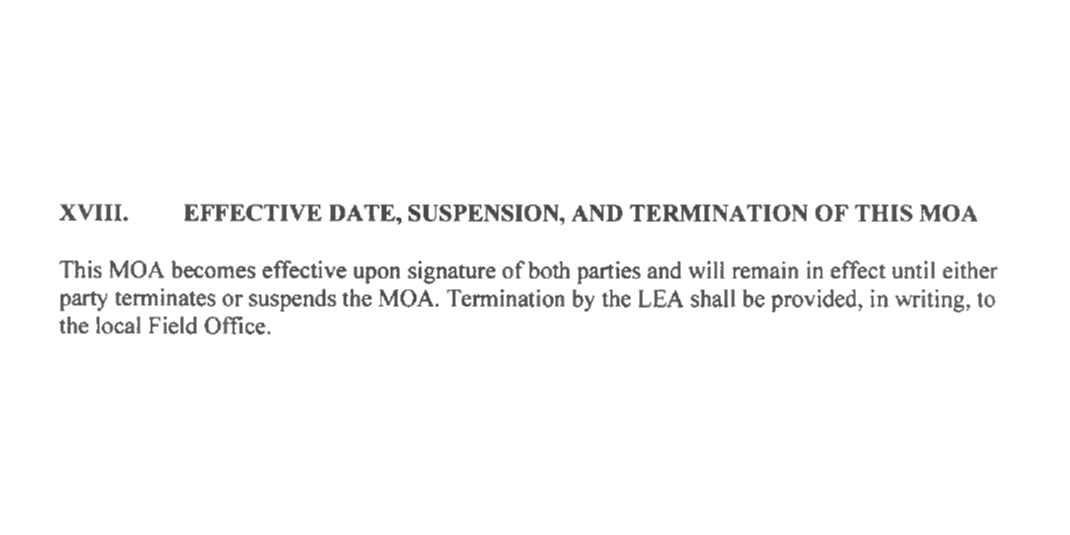
A signed agreement between ICE and the Bedford County Sheriff’s Office shows what an exit can look like. Its termination section says either party can end the agreement and directs the sheriff’s office to notify the local ICE field office in writing. The agreement’s current status is unclear. In the opinion’s Contracts Clause analysis, the majority said every agreement covered by the injunction already let the state or local party pull out without cause. That undercut the federal government’s argument that Virginia was substantially impairing its agreements by imposing new terms for continued cooperation.
The majority said federal authorities could turn down Virginia’s terms and continue enforcing federal law without the state’s help. The court drew a different line at Virginia’s mask and identification statute. It concluded that the federal government was likely to show that applying those rules directly to federal personnel carrying out federal duties violated intergovernmental immunity, the constitutional principle that limits one government’s power to regulate the other. Judge Robert B. King agreed with the outcome on the agreements but dissented on masks and identification, arguing that Virginia’s law could validly apply to federal officers.
The decision resolves appeals over interim relief in the federal government’s lawsuit. The next procedural marker for the agreements ruling is the mandate. Under the Fourth Circuit’s Rule 41, the appellate judgment takes effect when the mandate issues, and the court can change the ordinary timing.